
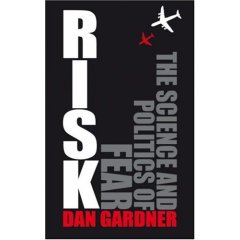
The Economists reviews of “Risk: The Science and Politics of Fear” by Dan Gardner
THE official death toll from the September 11th terrorist attacks in 2001 was 2,974. But in 2002 America’s death toll on the roads grew by more than 1,500—casualties of the terrorism-inspired exodus from safe aeroplanes to dangerous motor cars. A swan washes up on a British shore, dead from bird flu, and the press panics, while the 3,000 people who die every year on the country’s roads (13 times the number of people who have ever died from bird flu) go largely unremarked. Human beings are notoriously bad at dealing with risk. Two new books explore why, and investigate the effects that misunderstanding risks can have on public policy. The first, an excellent work by a Canadian writer, Dan Gardner, is a broad meditation on the nature of risk, beginning with a psychological explanation for why people find it so difficult to cope. Mr Gardner analyses everything from the media’s predilection for irrational scare stories to the cynical use of fear by politicians pushing a particular agenda.
My Notes — Teaching
August 21, 2007 · Management Teaching
Introducing the Meeting Meter?
Are you participating in too many meetings? Are these meetings too long? Time is money and group time costs much more money than the time of a single person. With the Meeting Meter™ you can develop an agenda and calculate the true cost of meetings while they take place. The Meeting Meter™ is a simple… More »
What CEOs are Reading
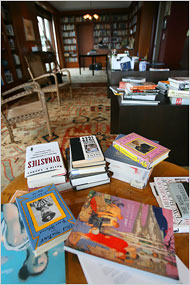
The common perception is that CEOs are reading the latest popular management books to help them with their difficult job. An article in the New York Times suggests otherwise. I am not sure if the CEOs that Harriet Rubin portrays in here article are representative of all CEOs and I think the title of the article “C.E.O. Libraries Reveal Keys to Success” is an overstatement, but any manager should read what she has to say.
Harriet Rubin: Michael Moritz, the venture capitalist who built a personal $1.5 billion fortune discovering the likes of Google, YouTube, Yahoo and PayPal, and taking them public, may seem preternaturally in tune with new media. But it is the imprint of old media — books by the thousands sprawling through his Bay Area house — that occupies his mind. “My wife calls me the Imelda Marcos of books,” Mr. Moritz said in an interview. “As soon as a book enters our home it is guaranteed a permanent place in our lives. Because I have never been able to part with even one, they have gradually accumulated like sediment.” Serious leaders who are serious readers build personal libraries dedicated to how to think, not how to compete. Ken Lopez, a bookseller in Hadley, Mass., says it is impossible to put together a serious library on almost any subject for less than several hundred thousand dollars. Perhaps that is why — more than their sex lives or bank accounts — chief executives keep their libraries private.

April 12, 2007 · Uncategorized Teaching
New School of Strategy & Entrepreneurship launched in Sydney
The UNSW Academic Board has approved the creation of a new School of Strategy and Entrepreneurship within the Faculty of Business (incorporating AGSM) to continue AGSM’s general management teaching and research. To be headed by Associate Professor Peter Murmann, the new school will focus on innovation and entrepreneurship as a subject within general business. Welcoming the move, Professor Alec Cameron, Dean of UNSW’s Faculty of Business (incorporating AGSM), said the new schools’ vision was to be recognised as Australia’s leading cluster of scholarship in the area of strategy and entrepreneurship research, teaching and executive development. “After the integration of AGSM and the Faculty of Commerce and Economics there were several existing schools but none was dedicated to general management and strategy,” said Professor Cameron. “So as part of the integration the idea was to create a separate school, and to include entrepreneurship to highlight the fact that the concerns of the general manager and the entrepreneur were both being addressed and people were being prepared for these roles.”
November 5, 2006 · Uncategorized Teaching
The Global Climate Crisis
The website for An Inconvenient Truth provides the basics facts about the science of climate change. Watch the trailer for film. Give the DVD to your friends this holiday season. Commissioned by the British government, the economist Stern published on October 30th his study evaluating the economic consequences of global warming. He writes: "The scientific… More »

July 26, 2006 · Uncategorized Teaching
Reflections On “The Long Tail” – Give me Good Data!
A few days ago, I came across a very positive review of The Long Tail, a new book by Wired Maganize writer Chris Anderson. The book's main thesis is that "the future of commerce and culture isn't in hits, the high-volume head of a traditional demand curve, but in what used to be regarded as… More »
November 14, 2005 · Management Teaching
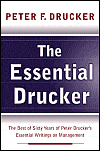
The Essential Drucker: The Best of Sixty Years of Peter Drucker’s Essential Writings on Management
One of the things that made Peter Drucker such a superb writer on management was his intense and wide ranging curiosity about everything in the world and his keen eye for the essential aspects of reality. Unlike many other people who paid with their life for not wanting to see reality, Drucker, for example, extrapolated from what Hitler had said in the years before becoming Chancellor of Germany in 1933 and left for England the moment Hitler rose to power. Drucker died a few days ago at age 95, but many of his insights are as valid as ever. Drucker’s writings have been edited into one book a few years ago, which is available electronically on Kindle. The value of the book lies not so much in giving concrete instructions about what you should do as a manger but in making you think about your own situation. Here are some of the key insights, the foremost being that management is about human beings.

September 30, 2005 · Psychology Teaching
Even the Best Cannot Predict the Future
It is very useful to recognize that the social world is too complex to predict well what will succeed and what will fail. Those who think they know with great certainty what will succeed run the danger of overinvesting in their pet scenarios. What is the lesson? Just like with stocks, we should always have a portfolio of beliefs about the future, reducing the risk of getting stuck with the wrong scenarios.
“I think there is a world market for maybe five computers.”
–Thomas Watson, chairman of IBM, 1943
Computers in the future may weigh no more than 1.5 tons.”
–Popular Mechanics, forecasting the relentless march of science, 1949
“I have traveled the length and breadth of this country and talked with the best people, and I can assure you that data processing is a fad that won’t last out the year.”
–The editor in charge of business books for Prentice Hall, 1957
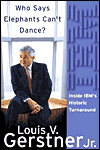
Who Says Elephants Can’t Dance: Inside IBM’s Historic Turnaround
In the early 1990s, IBM was in danger of going bankrupt. Loius Gerstner was called in to turn the company around. Anyone who is trying to change a formerly successful orgazation will benefit from reading Gerstner's thoughts on change management. Beware: the book starts out slow, turning off many readers. But after the first 20… More »

July 3, 2005 · Psychology Teaching
The Freedom Tower Case: Why is group decision making not better individual decisions
Individual human beings have limited skills, knowledge, and expertise can get carried away by emotions when making decisions. One would think that involving multiple people in a decision could overcome the limitations of individual decision making but social psycholgoists have long known that groups have their own limitations. The New York Times published a pertinent article on how a comittee came up with the redesigned Freedom Tower that architectual critics find dissappointing given the grandeur of the originial proposal.