
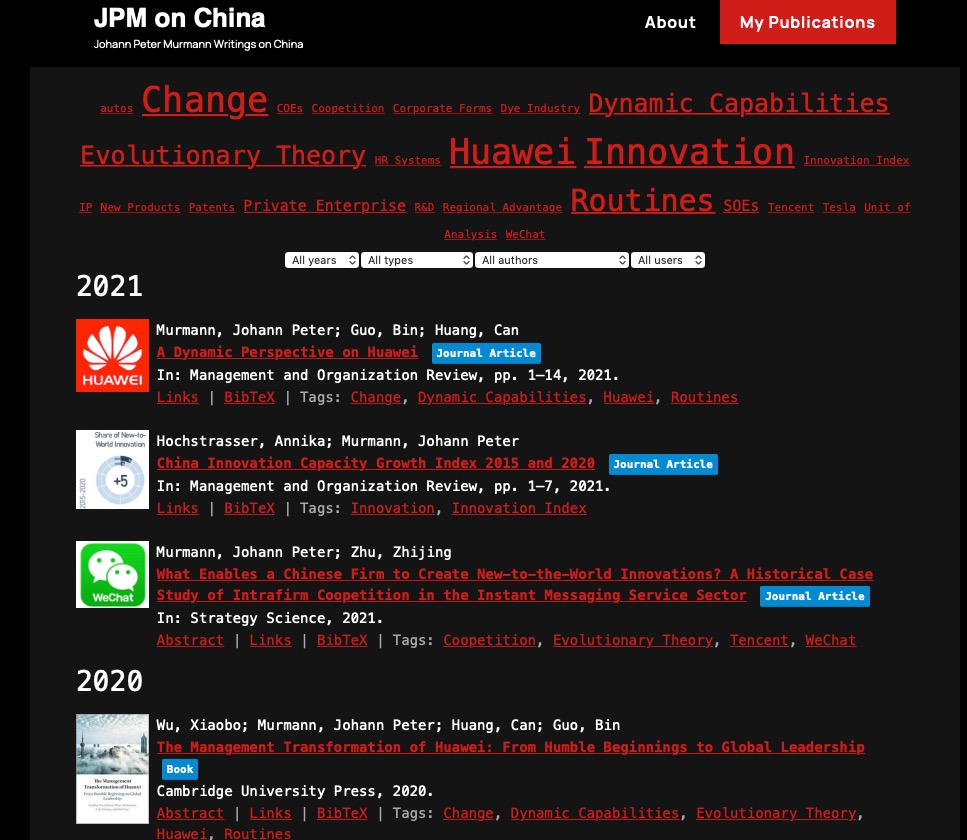
I collected all my Writings on Chinese Firms and Innovation in the Chinese Economy in one place.
 .
I collected all my Writings on Chinese Firms and Innovation in the Chinese Economy in one place.
.
The China expert Peter Hessler has written an informative letter on How China Controlled the Coronavirus drawing on his experience on teaching a class on non-fiction writing in Sichuan during the pandemic. Read Article. You can listen to a podcast of the article as well.
Huawei has become China's most prominent multinational company and a leader in the ICT sector. Given unprecedented access to the company, the authors of this book examine the management transformation of Huawei from its inception in 1987 until 2019, observing in detail not only the creation of its organizational routines but also the breaking of… More »
I did a four-minute interview with the HSG Focus Magazine.
I wanted to test with a computer simulation the explanations I offered in my book Knowledge and Competitive Advantage: The Coevolution of Firms, Technology and National Institutions for why German firms overtook their French and British competitors in the Synthetic Dye Industry from 1857-1913. So I partnered with Thomas Brenner who has created a simulation… More »
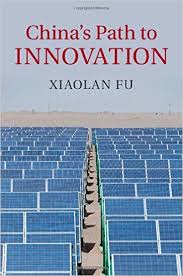
To date there are few research monographs that go beyond picking out striking cases of innovative companies. We clearly also need systematic analyses of China’s growing innovative capacity. For this reason, Xiaolan Fu’s book China's Path to Innovation (Cambridge University Press, 2015) is a welcome addition to the literature. Fu is Professor of Technology and… More »
This article has appeared in the journal "Business History", Volume 57, Issue 5, 2015. Abstract: How can business historians and evolutionary economists deepen their conversations? The paper argues that in doing detailed studies of how individual firms develop capabilities over time is where the concerns of business historians who want to tell the history of… More »
A lot of Chinese researchers simply want to imitate how top American journals in formulating theories without boundary conditions. This sounds like doing good science but more often its leads to superficial analyses that do not explain what is happening in China. I was asked to write a commentary on an article by Child and… More »
My article with Salih Ozdemir and Deepak Sardana was just published in Research Policy. Abstract: International new ventures (INVs) have been documented to exist all around the world, but the literature is silent on the frequency of such companies in different countries. We contend that the propensity of new ventures to internationalize by forming international… More »
This short article is my entry on Richard R. Nelson in the Encyclopedia of Strategic Management
Richard R. Nelson (b. 1930) is an American economist who has had a significant influence on the field of strategic management. The fundamental question driving his work is how societies can be organized to improve their material well-being. In answering this question, Nelson identifies sustained technological innovation and a diverse range of often industry-specific institutional structures as the key engines of economic growth. He sees business firms as playing a key role in the growth process because firms are the carriers of the knowledge and abilities required to produce the complex product and services that characterize modern economies.
Keywords: evolutionary theory, firms, innovation, organizational capabilities, patents, Carnegie School, RAND Corporation; science policy, tacit knowledg