
My research team is interested in studying how to improve strategic forecasting ability. As a key empirical context, we have selected the auto industry undergoing dramatic technological changes.
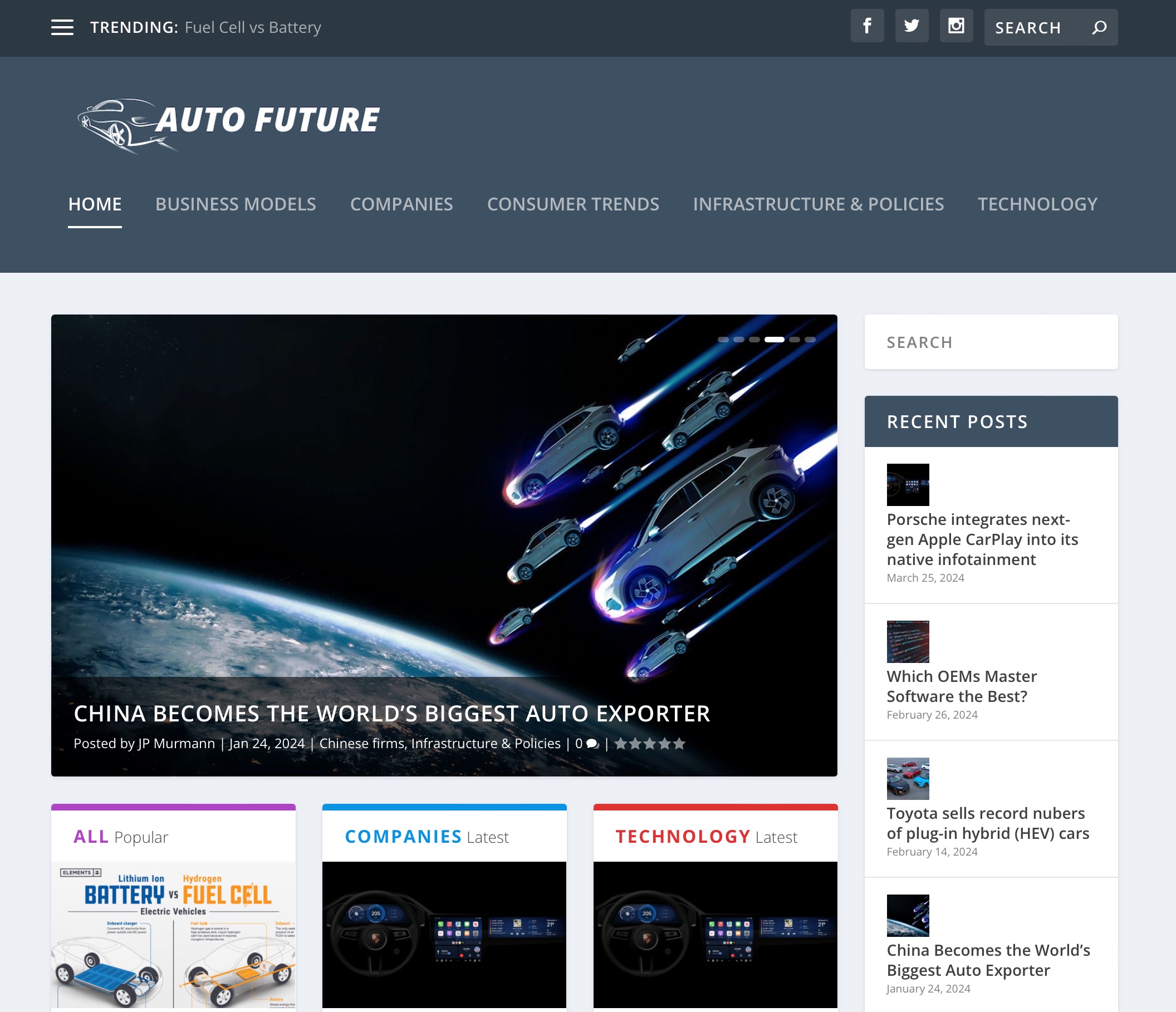
Click on the picture to access auto-future.org
My research team is interested in studying how to improve strategic forecasting ability. As a key empirical context, we have selected the auto industry undergoing dramatic technological changes.
Click on the picture to access auto-future.org
I have two new publications about the new competition in the auto industry. A Capabilities Framework for Dynamic Competition: Assessing the Relative Chances of Incumbents, Start-Ups, and Diversifying Entrants (with Fabian Vogt in Management and Organization Review) Exploring the structure of internal combustion engine and battery electric vehicles: implications for the architecture of the automotive… More »
In this forum, we present three essays that collectively seek to document and explain the rise of China's digital economy. The first essay written by Hong Jiang – who is based in China – and myself – who is based in the West – focuses on documenting the rise of China's digital economy by comparing… More »
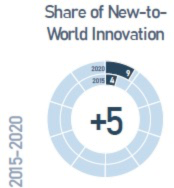
It is of interest in China and across the world to predict whether China will catch up with the most economically advanced nations in innovation capacity. To facilitate an ongoing assessment of China’s innovation capacity, the article develops a China Innovation Capacity Growth Index composed of eight separate measures. China’s performance in 2020 is compared… More »
I collected all my Writings on Chinese Firms and Innovation in the Chinese Economy in one place.
 .
Peter Ping Lee interviews James March. I provide here what I personally found the most interesting part of the full interview. Peter: In your MOR 2005 article (March 2005), you referred to the peripheral position of the indigenous research communities relative to the mainstream research community. Do you think the Chinese research community is like… More »
Brent Goldfarb and David A. Kirsch. Bubbles and Crashes: The Boom and Bust of Technological Innovation. Stanford, CA: Stanford University Press, 2019. 247 pp. $35.00, cloth.
Financial bubbles have been a recurring phenomenon throughout the history of capitalism that have proved costly for society. According to the U.S. Bureau of Economic Analysis, the most recent financial crisis from 2007 to 2009 resulted in a real GDP loss of $650 billion. The U.S. Government Accountability Office (2013: 12) called it the “most severe economic downturn since the Great Depression of the 1930s.”
Given that financial bubbles are more the domain of finance scholars and economists, why should ASQ readers read a book on Bubbles and Crashes? Its subtitle—The Boom and Bust of Technological Innovation—is what makes the book interesting for organizational scholars. Beginning with the famous Aston studies, organizational scholars have increasingly focused on technology as a key shaper, first of individual organizations (Hage and Aiken, 1969) and later of entire populations of organizations (Tushman and Anderson, 1986). The recent interest in “disruption” typically involves a new technology that a startup develops for a niche market. Subsequently the technology is so much improved that the startup can bring it to the core market where it disrupts the leadership position of incumbent firms (Christensen, 1997). Goldfarb and Kirsch extend this literature by examining the role of technological innovation in the formation of bubbles in financial markets. They aim to identify the key causal mechanisms that increase the likelihood of the formation of a speculative bubble.
The book is divided into six chapters. After a brief introduction outlining the most important elements of their theory about the formation of speculative bubbles, chapter 1 introduces the central concepts necessary to differentiate bubbles from non-bubbles. Bubbles are those “boom and bust episodes in which investors drive up prices and get fooled” (p. 24). To determine whether there is a bubble, the authors develop a measure called “frothiness” that represents “the number of standard deviations from the predicted stock or index trend . . . where the ‘trend’ is the predicted stock price looking forward and backward seven years” (p. 35). In short, the measure indicates whether stock prices are inflated. If the frothiness is larger than 2, the stock price is a candidate for a bubble, but the authors bring to bear additional judgments to determine whether investors were fooled. Chapter 2 describes the role of uncertainty and narratives in the formation of bubbles. The authors differentiate four types of uncertainty: technological uncertainty, competitive uncertainty, business model and value chain uncertainty, and demand uncertainty. And they conceptualize narratives—which emerge in an unexpected starring role in the book––as “temporally sequenced accounts of interrelated events or actions undertaken by characters” (p. 51). Chapter 3 explains what role novices, naïfs, and biases play in the formation of bubbles. While chapters 2 and 3 constitute Goldfarb and Kirsch’s theory on the causes of speculative bubbles driven by technological innovation, chapter 4 applies their framework to a sample of technologies to test its explanatory power. In chapter 5 Goldfarb and Kirsch test the external validity of their theory by applying the framework to a different sample of more recent technologies. Chapter 6 derives policy implications from the framework and gives practical advice on how one can assess the probability of being in a bubble. The appendix provides further information on the methods, a summary of the main findings in tables, and a comprehensive list of sources used for writing the detailed histories of the technologies.
Huawei has become China's most prominent multinational company and a leader in the ICT sector. Given unprecedented access to the company, the authors of this book examine the management transformation of Huawei from its inception in 1987 until 2019, observing in detail not only the creation of its organizational routines but also the breaking of… More »
GM had a hydrogen-powered bus in 1967. VW and Mercedes had experimental hydrogen-powered cars in mid-1970s. Here is a list of vehicles produced by various companies. WSJ.com has produced a great video explaining why hydrogen cars are still not around the corner, despite the technology’s great promise.
India began the process of market liberalization that opened it to significant interactions with the world economy in 1991. In this essay, we provide an overarching view of the country's journey toward integration with the global innovation and entrepreneurship network. Major nodes in this global network have two major components that may be metaphorically referred… More »