

I have two new publications about the new competition in the auto industry. A Capabilities Framework for Dynamic Competition: Assessing the Relative Chances of Incumbents, Start-Ups, and Diversifying Entrants (with Fabian Vogt in Management and Organization Review) Exploring the structure of internal combustion engine and battery electric vehicles: implications for the architecture of the automotive… More »
My Notes — Writing

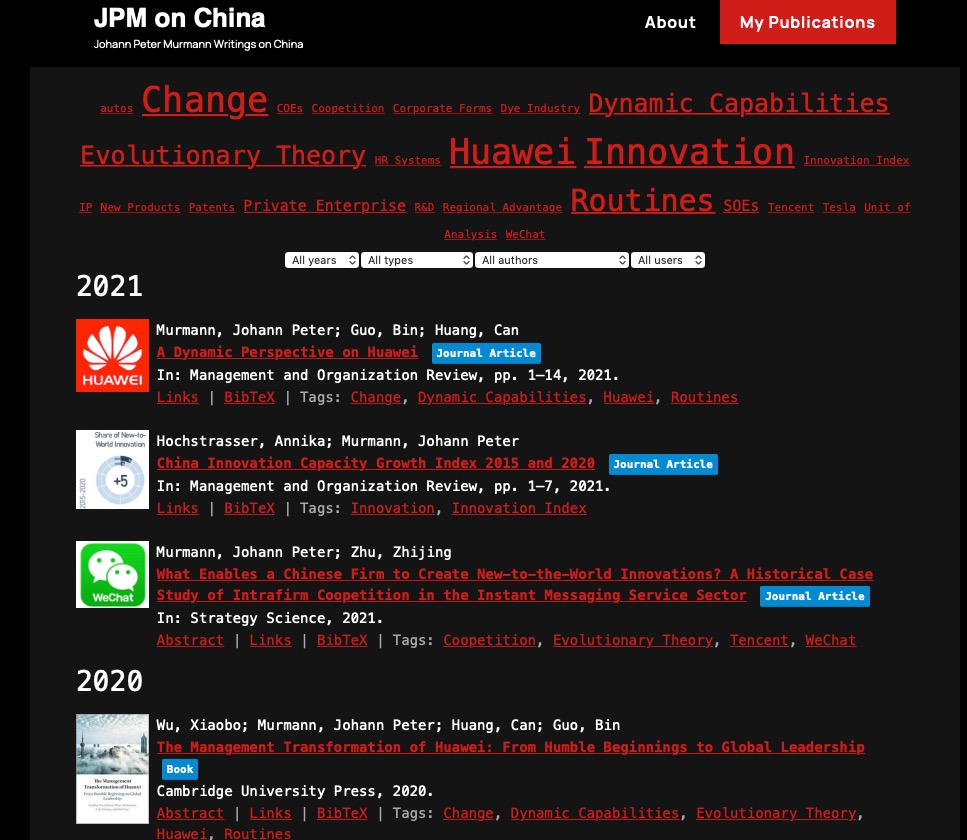
My Writings on Chinese Firms and Innovation in the Chinese Economy
I collected all my Writings on Chinese Firms and Innovation in the Chinese Economy in one place.
 .

The Management Transformation of Huawei: From Humble Beginnings to Global Leadership
Huawei has become China's most prominent multinational company and a leader in the ICT sector. Given unprecedented access to the company, the authors of this book examine the management transformation of Huawei from its inception in 1987 until 2019, observing in detail not only the creation of its organizational routines but also the breaking of… More »

“We do not do PowerPoint at Amazon”
Jeff Bezos explains in an annual letter to shareholders that Amazon bans PowerPoint presentations. Six-Page Narratives We don’t do PowerPoint (or any other slide-oriented) presentations at Amazon. Instead, we write narratively structured six-page memos. We silently read one at the beginning of each meeting in a kind of “study hall.” Not surprisingly, the quality of… More »

What Does the Success of Tesla Mean for the Future Dynamics in the Global Automobile Sector?
After reading Jacobides, MacDuffie, and Tae (2016), the success of Tesla in launching a new automobile company in a crowded sector puzzled us. Jacobides, MacDuffie, and Tae (2016) had convinced us that developing the capabilities to become the manufacturer of a complete, safe automobile system would be quite difficult. Researching the development history of Tesla,… More »

Useful if you consider submitting to AMJ: Editorial Statement by Current Editor of AMJ
I just read the editorial statement of the current editor of AMJ. If you would like to write about big problems that managers are facing in a scholarly way, AMJ may be a great outlet. Gerry George writes: A compelling way to frame a study for theoretical contribution is by asking questions on important anomalies… More »

Touchstones: Examples of Excellent Papers
Empirical Papers
Here are examples of excellent papers that I encourage people to use as touchstones and imitate when written small-n or case study papers.
Danneels, E. (2011). “Trying to become a different type of company: dynamic capability at Smith Corona.” Strategic Management Journal 32(1): 1-31.
Mirabeau, L., & Maguire, S. (2014). From autonomous strategic behavior to emergent strategy. Strategic Management Journal, 35(8): 1202-1229.
Miller, R., M. Hobday, T. Leroux-Demers and X. Olleros (1995). “Innovation in Complex System Industries: the Case of Flight Simulation.” Industrial and Corporate Change 4(2): 363-400.
Murmann, J. P. (2013). “The Coevolution of Industries and Important Features of their Environments.” Organization Science 24(1): 58-78.
Siggelkow, N. (2002). “Evolution toward Fit.” Administrative Science Quarterly 47(1): 125-159.
On Method
Here are some methodological texts that I found particularly useful in helping me refine my case study design skills.

A Conversation with Malcom Gladwell
Peter Capelli recently interviewed Malcolm Gladwell for Knowledge@Wharton. Gladwell talks about the relationship of what he does to academic research and makes this interesting observation. The sad fact about being a writer is that in a good year, you have five good ideas. It is not like it is every day; it is more like… More »

For every Social Scientists: Mattias K. Polborn translates an Ancient Letter from the Editor
Mattias K. Polborn writes: Preface I have recently found an ancient scroll, written in Reformed Egyptian, in my crawl space. It turned out to be a rejection letter from the editor of an ancient scientific journal, Geometrica, addressed to Ptolemaeus of Alexandria, the famous geographer. It is a remarkable document that shows how little scientific… More »

Jeffrey Meyers on Writing Habits
CM: Having written 43 books, including more than 20 biographies, you’re nothing if not prolific. What’s your work routine? JM: I work every day— it’s important to keep up momentum—from 9:30 to 1 in the morning and from 7:30 to 11 in the evening. In the afternoons I recharge by playing tennis (inexpensive psychotherapy), taking… More »