

According to Wikipedia, Ford owned Philco for 10 years starting in 1961. Hence the name Philco-Ford. The brand is now owned by Philipps.
My Notes

December 23, 2020 · Uncategorized Teaching
A Fly on the Wall in a Fearless Organization
JPM: Amy Edmondson has written a very thoughtful short overview of what an organization that creates psychological safety for its employees without sacrificing performance looks like. I highly recommend the piece. **What does psychological safety sound like?** The trickiest part of organizational change is translating the big idea into the little interactions that happen hundreds… More »

Peter Hessler: “How China Controlled the Coronavirus”
The China expert Peter Hessler has written an informative letter on How China Controlled the Coronavirus drawing on his experience on teaching a class on non-fiction writing in Sichuan during the pandemic. Read Article. You can listen to a podcast of the article as well.

May 27, 2020 · Uncategorized Research
Review of “Bubbles and Crashes” by Brent Goldfarb and David A. Kirsch
Brent Goldfarb and David A. Kirsch. Bubbles and Crashes: The Boom and Bust of Technological Innovation. Stanford, CA: Stanford University Press, 2019. 247 pp. $35.00, cloth.
Financial bubbles have been a recurring phenomenon throughout the history of capitalism that have proved costly for society. According to the U.S. Bureau of Economic Analysis, the most recent financial crisis from 2007 to 2009 resulted in a real GDP loss of $650 billion. The U.S. Government Accountability Office (2013: 12) called it the “most severe economic downturn since the Great Depression of the 1930s.”
Given that financial bubbles are more the domain of finance scholars and economists, why should ASQ readers read a book on Bubbles and Crashes? Its subtitle—The Boom and Bust of Technological Innovation—is what makes the book interesting for organizational scholars. Beginning with the famous Aston studies, organizational scholars have increasingly focused on technology as a key shaper, first of individual organizations (Hage and Aiken, 1969) and later of entire populations of organizations (Tushman and Anderson, 1986). The recent interest in “disruption” typically involves a new technology that a startup develops for a niche market. Subsequently the technology is so much improved that the startup can bring it to the core market where it disrupts the leadership position of incumbent firms (Christensen, 1997). Goldfarb and Kirsch extend this literature by examining the role of technological innovation in the formation of bubbles in financial markets. They aim to identify the key causal mechanisms that increase the likelihood of the formation of a speculative bubble.
The book is divided into six chapters. After a brief introduction outlining the most important elements of their theory about the formation of speculative bubbles, chapter 1 introduces the central concepts necessary to differentiate bubbles from non-bubbles. Bubbles are those “boom and bust episodes in which investors drive up prices and get fooled” (p. 24). To determine whether there is a bubble, the authors develop a measure called “frothiness” that represents “the number of standard deviations from the predicted stock or index trend . . . where the ‘trend’ is the predicted stock price looking forward and backward seven years” (p. 35). In short, the measure indicates whether stock prices are inflated. If the frothiness is larger than 2, the stock price is a candidate for a bubble, but the authors bring to bear additional judgments to determine whether investors were fooled. Chapter 2 describes the role of uncertainty and narratives in the formation of bubbles. The authors differentiate four types of uncertainty: technological uncertainty, competitive uncertainty, business model and value chain uncertainty, and demand uncertainty. And they conceptualize narratives—which emerge in an unexpected starring role in the book––as “temporally sequenced accounts of interrelated events or actions undertaken by characters” (p. 51). Chapter 3 explains what role novices, naïfs, and biases play in the formation of bubbles. While chapters 2 and 3 constitute Goldfarb and Kirsch’s theory on the causes of speculative bubbles driven by technological innovation, chapter 4 applies their framework to a sample of technologies to test its explanatory power. In chapter 5 Goldfarb and Kirsch test the external validity of their theory by applying the framework to a different sample of more recent technologies. Chapter 6 derives policy implications from the framework and gives practical advice on how one can assess the probability of being in a bubble. The appendix provides further information on the methods, a summary of the main findings in tables, and a comprehensive list of sources used for writing the detailed histories of the technologies.

The Management Transformation of Huawei: From Humble Beginnings to Global Leadership
Huawei has become China's most prominent multinational company and a leader in the ICT sector. Given unprecedented access to the company, the authors of this book examine the management transformation of Huawei from its inception in 1987 until 2019, observing in detail not only the creation of its organizational routines but also the breaking of… More »

March 21, 2020 · Uncategorized Teaching
Striking Similarities to Spanish Flue outbreak in 1918
We have heard about the similarities of COVID-19 to the Spanish flue, but here is it told well in a short video.

Why gave hydrogen-powered car not become mainstream even though they were hyped in already in 1974
GM had a hydrogen-powered bus in 1967. VW and Mercedes had experimental hydrogen-powered cars in mid-1970s. Here is a list of vehicles produced by various companies. WSJ.com has produced a great video explaining why hydrogen cars are still not around the corner, despite the technology’s great promise.

January 21, 2020 · Management Teaching
VW CEO uses history to explain why VW needs to speed up change to avoid the fate of Nokia
This is a Deepl AI translation of the speech of VW CEO to employees in January 2029. The complete speech of the VW boss in the wording:
“Ladies and gentlemen,
the world is on the move. Politically and technologically, we live in an incredibly dynamic time. A turn of an era stands before us – from the dimension of the industrial revolution. And Volkswagen is in the midst of the storm of the two greatest transformation processes:
– Climate change and the associated pressure to innovate towards emission-free driving.
– And digitalisation, which is fundamentally changing the automobile as a product.
Our Group is not always in the best position to react quickly and systematically enough to these developments. Measured against this, we have not done badly so far. This is also acknowledged by market observers. In 2019 in particular, analysts have gained new confidence in our strategy.
At the beginning of this year, Kepler Cheuvreux attested: “We think VW is the best positioned player in the industry to master the CO2 challenge. And Goldman Sachs says: “We expect VW Group to continue to prosper this year as a result of ongoing positive sales developments at VW brand, a pick-up in sales at Audi, and broadly flat margins.
In the Litigation area, we are making the risks from the diesel crisis more manageable step by step. In terms of corporate culture, we are seeing tangible and measurable progress. I am pleased that we have increased our integrity by three points in the sentiment barometer.
Our modern MQB-based model range in terms of volume and the new Porsches, Audis, Lamborghinis and Bentleys are convincing customers. We are improving the quality of our business. Revenue and earnings are growing faster than unit sales. In China, we increased our market share by 1.4 percent in a sharply declining market. This is a great achievement, which hardly anyone would have expected from us. Congratulations to Stephan Wöllenstein and his team on their outstanding performance!
In South America we are back in the black for the first time, and we have also turned our business around in Russia. In North America, we have significantly improved our earnings and are aiming to break even this year. Volkswagen Financial Services will have a record year in 2019, and the component has taken decisive steps in battery development and production.
At Audi, the e-tron got off to a successful start, development costs were reduced and a comprehensive cost reduction programme was launched. Porsche has once again delivered excellent figures and cars and set an example with the Taycan. Seat conquers new and young customers with Cupra. Skoda is running at full speed and will present the new models in India, an important future market for us, at the beginning of February.
VW Commercial Vehicles has put the extremely important Ford cooperation on track, and Traton has completed its IPO. We are seeing positive trends at Bentley, Ducati, Bugatti and Lamborghini, and Bentley in particular is back in the black. The Volkswagen core brand has worked hard to further increase returns. All in all: good developments.
“The storm is just beginning”

Framework and Toolkit for Improving Peripheral Strategic Vision
Day and Shoemaker have developed a useful framework and toolkit for assessing how much peripheral strategic vision your company needs.
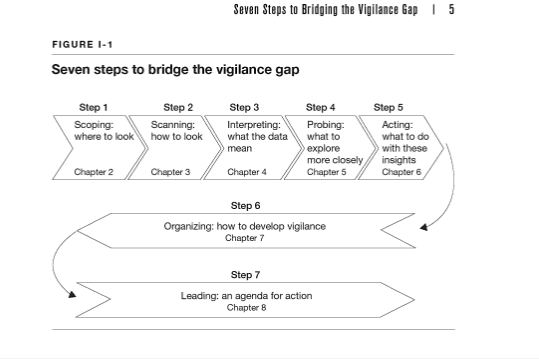
An MIT Sloan article lays out the ideas in three steps.

More details on the toolkit are in their HBR article that can be assessed here.

The Innovation and Entrepreneurship Ecosystem in India
India began the process of market liberalization that opened it to significant interactions with the world economy in 1991. In this essay, we provide an overarching view of the country's journey toward integration with the global innovation and entrepreneurship network. Major nodes in this global network have two major components that may be metaphorically referred… More »