

Tip 1: Don't go too fast. Recognize it can take several years to build a high-performance company. Tip 2: Get back to putting the customer first. As simple as that sounds, companies take it for granted. Tip 3: Don't let your sales force take no for an answer. They should tell clients: 'Talk to my… More »
My Notes

May 22, 2005 · Management Research
How Business Schools Lost their Way
Warren Bennis and James O’Toole just published an article in the Harvard Business Review that I wholeheartedly agree with. It is very fun to read because they are well-informed and don’t shy away from stating some unpleasant truths. Good business schools have room for theoreticians, scientific empiricists, and practice oriented scholars.

Commanding Heights: The Battle for the World Economy
Rarely have I seen such a powerful documentary about how ideas shape the world. The film traces the ideas that shaped macro-economic policy making over the course of the 20th century. The film will be eye-opening for people who know very little how economic policy powerfully effects the welfare of societies all over the world.… More »
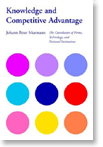
The Stanley Reiter Lecture 2005
On January 26, 2005 I delivered the Stanley Reiter Award Lecture. The Reiter award is named for Stanley Reiter, Charles E. and Emma H. Morrison Professor of Managerial Economics and Decision Sciences at Kellogg. It is presented to a Kellogg faculty member whose paper is judged by a panel of Kellogg professors across disciplines to be the best paper written in the preceding four calendar years. I received the award for my book Knowledge and Competitive Advantage: The Coevolution of Firms, Technology and National Institutions. You can also read the text of the lecture by clicking on “More” button or by downloading it as a Word file. Alternatively, you can watch a video (58 minutes) of the lecture with Real Player here: Lecture Video. If you watch the video, you should download the Slides that I presented during the lecture but which are not visible in the video.

January 24, 2005 · Management Teaching
What Companies do to Make Life Easier for Their Employees
The WSJ in today’s report on leadership published an interesting article on what kind of perks companies provide to boost the morale of people and to make work life easier. “Fun perks didn’t end with the dot-com bust. They just changed,” reports Jennifer Saranow.
Read the full article on WSJ.com.

January 20, 2005 · Psychology Teaching
Four More Years of Happiness
Harvard pychology professor Daniel Gilbert predicts that most democrats will not be depressed during the next four years of George Bush. Here is the rationale that he offers in today’s New York Times: Research suggests that human beings have a remarkable ability to manufacture happiness. For example, when people in experiments are randomly awarded one of two equally valuable prizes, they quickly come to believe that the prize they won was more valuable than the prize they lost. They are often so surprised by their apparent good fortune that they refuse to believe the prize was awarded randomly, and they are generally unwilling to swap their prizes even when the experimenter offers to sweeten the deal with a little extra cash.

The Power of Richness: The Why, When, Where and How of Qualitative Research Methods
Participate in the workshop on Qualitative Methods the Academy of Management in Hawaii, Friday afternoon from 1:00 to 4:00, August 5, 2005. The Panelists are: Robert Burgelman, Diana Day, Deborah Dougherty, Charles Galunic, Johann Peter Murmann, Gabriel Szulanski, and Klaus Weber.
Visit the Discussion Forum for the Event where much additional information will be posted.

Malcom Gladwell’s Book “Blink” is out!
In my introductory management class I discuss the how cognitive heuristics (rules of thump) help us navigate our complex daily lives and make decisions before it is too late. Malcom Glawell new book describes this quick decision-making capability with many examples. I will review the book during the next couple of months, but in the… More »

January 11, 2005 · Psychology Teaching
Gladwell and Surowiecki Debate How Good Decisions are made
Galdwell and Surowiecki have a new books coming out concerned with good decision making. I am presently reading Surowieki’s The Wisdom of Crowds and have Blink on my reading list. You can read a debate they both had about their books in Slate

Social Mechanisms: An Analytical Approach to Social Theory
I am a big fan of explanations of social phenomena that set forth the precise causal mechanisms that produce them. This book edited by Peter Hedstroem and Richard Swedberg provides a very good introduction to the approach. The only think I don’t like about the piece its believe that all mechanisms in sociology need to refer to individuals. You can download the overview chapter here: Social-mechanism.pdf Click on “More…” for a Table of Contents.