
Chinese scientists have carried out a powerful meta-analysis and created new knowledge about the chemical pathways that lead to addiction. Can social scientist imitate this model? I am not sure. But certainly we should strive to do so. Dr Wei therefore ran her 396 genes through a database of all known pathways to see which… More »
My Notes — Research

December 27, 2007 · Psychology Research
Malcom Gladwell Reviews the Problems with IQ Measurements
This is an excellent piece that shows how important it is to actually understand how IQ measures are constructed. Any empirical researcher can learn from the New Zealander who showed how much the alleged genetic intelligence is socially constructed. Read NONE OF THE ABOVE: What I.Q. doesn’t tell you about race.

July 19, 2007 · Methodology Research
Charles Tilly’s Writings on Methodology now on the Web
Charles Tilly is one of the most innovative and productive social scientists alive. His research know-how should be passed on to the next generation of researchers, not only to those who are fortunate to take his classes at Columbia University. With the approval of Tilly, Sekou Bermiss and I made electronically available all his writings… More »

The Power of Richness III: Crafting Qualitative Research Papers
The large crowds that came to the Power of Richness PDWs in Atlanta and the year before in Hawaii have convinced us there is significant demand in the Academy for learning how to do qualitative research well. This year we will build on the success of our two previous qualitative methods PDWs and create an… More »
May 6, 2006 · Uncategorized Research
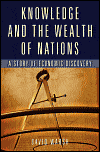
Knowledge and the Wealth of Nations: A Story of Economic Discovery
David Warsh tell the story of how the idea of increasing returns that was already present in Adam’s Smith’s Wealth of Nations transformed academic economics in the 1980s. Read Paul Krugam’s review in the New York Times.

Malcom Gladwell Reviews Charles Tilly’s New Book “WHY”
Gladwell writes: In "Why?" (Princeton; $24.95), the Columbia University scholar Charles Tilly sets out to make sense of our reasons for giving reasons. In the tradition of the legendary sociologist Erving Goffman, Tilly seeks to decode the structure of everyday social interaction, and the result is a book that forces readers to reexamine everything from… More »

The Power of Richness II: Exploring Qualitative Research Methods
Inspired by the large number of participants at the "The Power of Richness: The Why, When, Where and How of Qualitative Research Methods" PDW in Honolulu, Diana Day and I (Peter Murmann) decided to organize a follow-up workshop on qualitative methods at the academy meeting in Atlanta. The workshop will again have a stellar group… More »

July 15, 2005 · Uncategorized Research
Project on the Competitiveness of Firms in the Global Paper & Pulp Industry, 1805-2005
Together with two Finish scholars, Juha-Anti Lamberg and Jari Ojala, I started a comparative study of the paper and pulp industry. Human beings have been making paper from various raw materials for thousands of years. But in 1804 a Frenchman invented a continous paper machine revolutionized the manufacturing and started the modern paper making industry.
The goal of our project is to study shifts in competitive advantage from one country to the next and from firm to firm during the last 200 years. We are starting our comparative analysis looking at Britain, Germany, Finland and Sweden. Our long-term plan is to study all the major paper producing countries in the word. If you are interested in participating in this study, contact us.

May 22, 2005 · Management Research
How Business Schools Lost their Way
Warren Bennis and James O’Toole just published an article in the Harvard Business Review that I wholeheartedly agree with. It is very fun to read because they are well-informed and don’t shy away from stating some unpleasant truths. Good business schools have room for theoreticians, scientific empiricists, and practice oriented scholars.

The Stanley Reiter Lecture 2005
On January 26, 2005 I delivered the Stanley Reiter Award Lecture. The Reiter award is named for Stanley Reiter, Charles E. and Emma H. Morrison Professor of Managerial Economics and Decision Sciences at Kellogg. It is presented to a Kellogg faculty member whose paper is judged by a panel of Kellogg professors across disciplines to be the best paper written in the preceding four calendar years. I received the award for my book Knowledge and Competitive Advantage: The Coevolution of Firms, Technology and National Institutions. You can also read the text of the lecture by clicking on “More” button or by downloading it as a Word file. Alternatively, you can watch a video (58 minutes) of the lecture with Real Player here: Lecture Video. If you watch the video, you should download the Slides that I presented during the lecture but which are not visible in the video.