
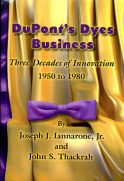
Joseph Innarone and John Tackray are two former members of the DuPont dye business that experienced its golden age after World War II and was sold off in 1979, marking the visible onset of the decline of the U.S. synthetic dye industry. The authors are not research chemists. For the entire period covered by the book, they both held different jobs in the dye business, spanning technical service, sales, and business management. In course of their various assignments that started for both of them as trainees in the Technical Laboratory, the authors acquired substantial knowledge of dye innovations and the business of selling dyes. Rather than attempting a scholarly history (only five sources are cited), the authors offer their own personal history of Du Pont’s dye business. Their story is valuable for anyone who wants to gain a deeper understanding how DuPont became an innovator in the synthetic dye industry yet in the 1970s could no longer compete successfully with foreign rivals. Du Pont exited the industry in 1979 as later did all other U.S. headquartered firms. Download full Review in AMBIX, Vol. 57 No. 3, November, 2010.
My Notes — Research

Constructing Relational Databases to Study Life Histories on Your PC or Mac
In this article, I present a strategy for designing relational databases with the program FileMaker Pro (FileMaker) to study the histories of individuals and organizations. The approach facilitates efficiency in inputting data and flexibility for constructing statistical analyses from the rawdata. The key feature of the strategy is to define the basic unit of observation… More »

Evolutionary Economics Meets Business History at Trinity College in Dublin
I participated in a workshop bringing together Business Historians and Evolutionary Economists at Trinity College in Dublin. Overview information on the workshop and the presentation slides have been posted in the Economic-Evolution.net discussion forum.

Problems with the Peer Review System in Science
Frank Furedi has written a very thoughtful essay on the problems with current peer review system in science. In my view, the issues are a lot more serious in the social sciences where is much harder to formulate non-trivial general laws and make precise predictions that can be proven or disproven. The natural sciences require… More »

Jeffrey Meyers on Writing Habits
CM: Having written 43 books, including more than 20 biographies, you’re nothing if not prolific. What’s your work routine? JM: I work every day— it’s important to keep up momentum—from 9:30 to 1 in the morning and from 7:30 to 11 in the evening. In the afternoons I recharge by playing tennis (inexpensive psychotherapy), taking… More »

Economics: Is the discipline in crisis?
Drake Bennett of the Boston Globe is reporting on the soul searching that is going on the field of economics and finance after the professions inability to foresee the crisis. THE DEEPENING ECONOMIC downturn has been hard on a lot of people, but it has been hard in a particular way for economists. For most… More »

Paulson on the diversity of firm in the financial industry
Trying to imitate high-status Newtonian physics, management scholars over the past fifty hear have tried to formulate general laws about the behavior of organizations. In his statement after the passing of the $700 billion bailout of the financial industry, Paulson in my view correctly emphasized that the salient fact about most industries is the diversity and not the sameness of firms within them.

Charles Tilly 1929- 2008
I don’t know anyone who has come in contact with Charles Tilly and who was not inspired by him. For those who have never met him, here are wonderful tributes to this exemplary scholar.
Social Science Research Council Tribute Website
Tributes by Scholars
NY Times Obituary
Automatic Coding of Printed Materials
Traditionally most researchers working with printed data sources have entered data by hand to convert it into electronic format. If a research project involves large amounts of data from similarly formatted sources – for example, when one tries to create a longitudinal database of directory information spanning many years – entering this data by hand… More »

The Power of Richness IV: How Can Qualitative Methods Help us Ask Better Questions
Over 150 people came to the Power of Richness PDWs at each of the last three Academy meetings, drawing from many different divisions and interest groups. With the demand for the workshop running so strong, Diana Day and I will try to organize an All-Academy PDW for the next meeting Annaheim. The format this past… More »