

This chapter reviews the ideas that have been developed to describe the emergence and change of structures in three fields: Economics, Management, and Design of Technologies. The chapter focuses on one empirical setting, the economy, and more specifically how firms, industries, and technologies change over time. Today’s industrialized economies are very different from the economies… More »
My Notes — Research
October 5, 2013 · Methodology Research
Excerpts from Arthur Stinchcombe’s on “Theoretical Methods in Social History”
Ten years ago I read Stinchcombe’s “Theoretical Methods in Social History”. I recently reread the parts that I had highlighted and I thought it useful to share some key passages.[1]
One does not apply theory to history; rather ones uses history to develop theory. [2]
—-
It is rather that the fashion in quantitative history has come to be that one must agree to be voluntarily ignorant of the any evidence other than numbers. [3]As the argument develops, it will become clear why I am unenthusiastic about most quantitative history. Let me state the argument in capsule form.
For a number, say a count, to be theoretically interesting, it has to be a count of a comparable instance. What instances comparable for a scientist is that those instances have identical causal impact. Thus a count is more illuminating, the more theory and the more detailed examination of the facts went into making the instances counted comparable. But this ordinarily means that making a count should be the last stage of a scientific enterprise, a stage reached only after an extensive development of theory on what makes instances comparable. Is the proletarian in the Vyborg district of Petersburg or in the Baltic Sea Fleet equivalent in impact on the Russian Revolution to a proletarian in Moscow? Trotsky convinces me he was not (and if the proletarian was a she, in either place, she was not equivalent to a male proletarian either). Consequently, a count of proletarians in Russia in 1917 is fact of relatively little interest. [4]

August 31, 2013 · Uncategorized Research
My Editorial Statement for Management & Organization Review
MOR is the official journal of International Association for Chinese Management Research. While the journal is focused on China, comparative studies of China and other countries are highly appropriate for the journal. I am interested in detailed studies of how technologies, organizations, industries and supporting institutions evolve over time. Methodologically, I hope to attract comparative… More »

August 26, 2013 · Uncategorized Research
Collection of Research Methods articles in SO!
SO! has pulled together the collection of articles on research methods that the journal published over the years. I for one will come back to these articles. I suspect many doctoral students will find them useful. Ann Langley: Over the years, Strategic Organization has published a number of very useful and insightful articles on research… More »

AOM 2013: Two workshops I am participating in: History and Design Evolution
History and Strategy: Toward an Integration of Theory and Method History and Strategy
[color=red]New Presentation Slides for Download. [/color]Click here.
Program Session #: 80 | Submission: 14401 | Sponsor(s): (BPS, MH, TIM)
Scheduled: Friday, Aug 9 2013 11:45AM – 1:45PM at WDW Swan Resort in Swan 10
Organizer: Steven Kahl; Dartmouth College (TUCK);
Organizer: Brian S. Silverman; U. of Toronto;
Participant: David A. Kirsch; U. of Maryland;
Participant: Huseyin Leblebici; U. of Illinois;
Participant: J Peter Murmann; Australian School of Business, UNSW;
While historical research has played a central role in the development of the strategy literature, it remains underrepresented in strategy journals. This PDW explores how historical analysis can inform strategy research. As the strategy field continues to develop dynamic models of strategy, the historical perspective can provide unique perspective, and could potentially even develop a history-based theory of strategy. Yet, doing historical research in strategy faces methodological challenges given its different approach to the development of theory and use of evidence. Consequently, this PDW addresses the different opportunities available to strategy scholars to engage in the historical method. The format of the PDW is a combination of 1) presentations in which scholars experienced in conducting historical analysis within the strategy and organizational fields discuss the challenges of doing this work and 2) interactive breakout sessions in which participants break into smaller groups to discuss design of a historical study in topical strategy research areas, such as dynamic capabilities and industry evolution. These breakout sessions will help identify how the historical approach can make novel theoretical contributions and reveal roadmaps for pushing this work further.
Search Terms: History/Historical Analysis , Strategy , Theory and Methods
Architectural Strategy and Design Evolution in Business Ecosystems: Opportunities and Challenges
Ecosystem Design and Strategy
Program Session #: 279 | Submission: 10331 | Sponsor(s): (TIM, BPS, ENT, OMT)
Scheduled: Saturday, Aug 10 2013 10:15AM – 12:45PM at WDW Swan Resort in Swan 3

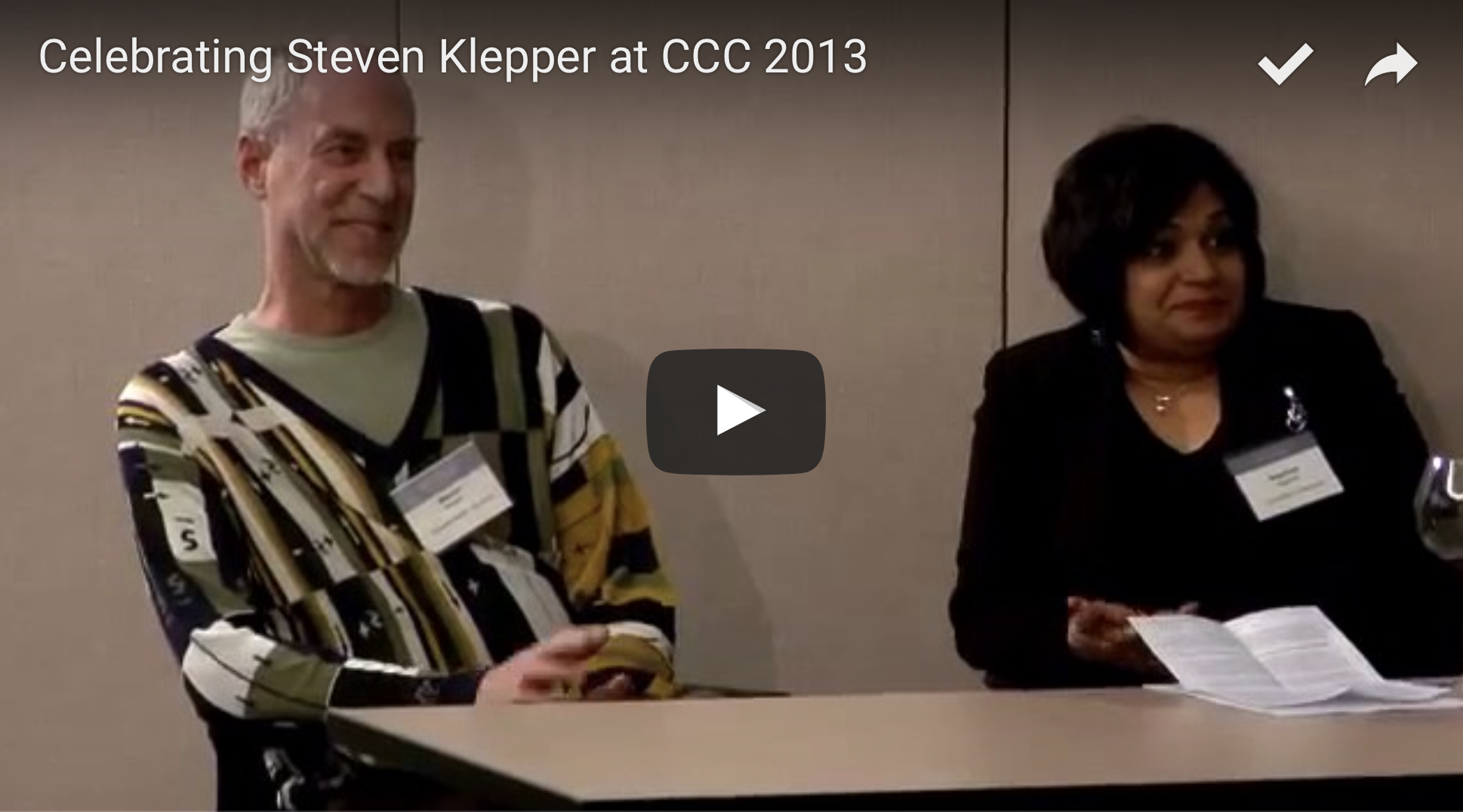
Honoring the late Steve Klepper
Steve Klepper, who has been an inspiration to so many of us, recently passed away. At the 20th anniversary of the CCC colloquium, we honored Steve Klepper. The video captures very nicely how much Steve touched an entire generation of doctoral students working on the intersection of industry evolution and technological innovation.

Nelson, Richard R. (born 1930)
This short article is my entry on Richard R. Nelson in the Encyclopedia of Strategic Management
Richard R. Nelson (b. 1930) is an American economist who has had a significant influence on the field of strategic management. The fundamental question driving his work is how societies can be organized to improve their material well-being. In answering this question, Nelson identifies sustained technological innovation and a diverse range of often industry-specific institutional structures as the key engines of economic growth. He sees business firms as playing a key role in the growth process because firms are the carriers of the knowledge and abilities required to produce the complex product and services that characterize modern economies.
Keywords: evolutionary theory, firms, innovation, organizational capabilities, patents, Carnegie School, RAND Corporation; science policy, tacit knowledg
Touchstones: Examples of Excellent Papers
Empirical Papers
Here are examples of excellent papers that I encourage people to use as touchstones and imitate when written small-n or case study papers.
Danneels, E. (2011). “Trying to become a different type of company: dynamic capability at Smith Corona.” Strategic Management Journal 32(1): 1-31.
Mirabeau, L., & Maguire, S. (2014). From autonomous strategic behavior to emergent strategy. Strategic Management Journal, 35(8): 1202-1229.
Miller, R., M. Hobday, T. Leroux-Demers and X. Olleros (1995). “Innovation in Complex System Industries: the Case of Flight Simulation.” Industrial and Corporate Change 4(2): 363-400.
Murmann, J. P. (2013). “The Coevolution of Industries and Important Features of their Environments.” Organization Science 24(1): 58-78.
Siggelkow, N. (2002). “Evolution toward Fit.” Administrative Science Quarterly 47(1): 125-159.
On Method
Here are some methodological texts that I found particularly useful in helping me refine my case study design skills.



April 6, 2013 · Publications Research
Successful Entrepreneurs Minimize Risk
Many scholars see entrepreneurs as action-oriented individuals who use rules of thumb and other mental heuristics to make decisions, but who do little systematic planning and analysis. In this new article, Deepak Sardana and I argue that what distinguishes successful from unsuccessful entrepreneurs is precisely that the former vary their decision-making styles, sometimes relying on… More »