

After reading Jacobides, MacDuffie, and Tae (2016), the success of Tesla in launching a new automobile company in a crowded sector puzzled us. Jacobides, MacDuffie, and Tae (2016) had convinced us that developing the capabilities to become the manufacturer of a complete, safe automobile system would be quite difficult. Researching the development history of Tesla,… More »
My Notes — Research

Interview with Professor Denise Rousseau
If you have been taught that relationship conflict (A-conflict) in teams is bad for team performance but arguing about tasks (C-conflict) is good, I encourage you to read my wide-ranging interview in BusinessThink with Professor Denise Rousseau (Carnegie Mellon University), the originator of this idea. After seeing the systematic evidence, she changed her mind and… More »

More Exploration and Less Exploitation: Cultivating Blockbuster Papers for MOR
Let me invite you to travel in your mind to the year 2030. Imagine that you are one of the Senior Editors of MOR and have been asked by the Editor-in-Chief to write a short retrospective on the previous 15 years. Delighted to take on this task, you compose an editorial along these lines: [I]Dear… More »

Using Simulation Experiments to Test Historical Explanations
I wanted to test with a computer simulation the explanations I offered in my book Knowledge and Competitive Advantage: The Coevolution of Firms, Technology and National Institutions for why German firms overtook their French and British competitors in the Synthetic Dye Industry from 1857-1913. So I partnered with Thomas Brenner who has created a simulation… More »

“The Moon and the Ghetto” revisited by Richard Nelson
Richard Nelson explained why is worthwhile to revisit his book. Over thirty years ago I wrote an extended essay, The Moon and the Ghetto, concerned with the troubling question of why societies so rich and capable technologically and organizationally as to be able to land a man on the moon seemed unable to deal effectively… More »
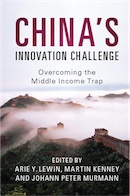
“China’s Innovation Challenge” published with Cambridge University Press
Arie Lewin, Martin Kenney and Johann Peter Murmann edited a new book on China's Innovation Challenge: Overcoming the Middle-Income Trap. New March 2016: Download Fronter Matter and Introductory Chapter The book will also feature contributions from Justin Yifu Lin, Gordon Redding, Michael Witt, Keun Lee, Douglas Fuller, John Child, Simon Collison, Yves Doz, Keeley Wilson,… More »
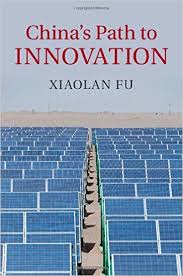
Review of “China’s Path to Innovation” by Xiaolan Fu
To date there are few research monographs that go beyond picking out striking cases of innovative companies. We clearly also need systematic analyses of China’s growing innovative capacity. For this reason, Xiaolan Fu’s book China's Path to Innovation (Cambridge University Press, 2015) is a welcome addition to the literature. Fu is Professor of Technology and… More »

July 1, 2015 · Publications Research
Deepening the Conversation Between Business History and Evolutionary Economics
This article has appeared in the journal "Business History", Volume 57, Issue 5, 2015. Abstract: How can business historians and evolutionary economists deepen their conversations? The paper argues that in doing detailed studies of how individual firms develop capabilities over time is where the concerns of business historians who want to tell the history of… More »

Tips for Choosing Appropriate Level of Abstractions (especially for Chinese Researchers)
A lot of Chinese researchers simply want to imitate how top American journals in formulating theories without boundary conditions. This sounds like doing good science but more often its leads to superficial analyses that do not explain what is happening in China. I was asked to write a commentary on an article by Child and… More »

The role of home country demand in the internationalization of new ventures
My article with Salih Ozdemir and Deepak Sardana was just published in Research Policy. Abstract: International new ventures (INVs) have been documented to exist all around the world, but the literature is silent on the frequency of such companies in different countries. We contend that the propensity of new ventures to internationalize by forming international… More »