

The jury is still out. But read this interesting exchange on NYTimes.com. Rember that just because on average women may be different than men, this does not mean that it is true for the person in front of you. Susan Pinker: Whether we’re talking about mentoring, managing or office politics, the research is clear: “Men… More »
My Notes — Psychology
Three Books on the Origins of the Financial Crisis and its Lessons
John Lanchester reviews three books on the origins of the financial crisis and its lessons in the New Yorker. Two of them are useful for the general reader. Gillian Tett, “Fool’s Gold” (Free Press) Richard A. Posner, “A Failure of Capitalism” (Harvard) I personally personally found Fools Gold the most rewarding of all the books… More »

Risk will always equal potential reward
Greed, as it periodically does when traders and bankers forget the lessons of the past, clouded judgments. Some very smart people talked themselves into believing in the repeal of one of the fundamental laws of economics: risk will always equal potential reward. The idea that risk can be eliminated and high yields guaranteed is as… More »

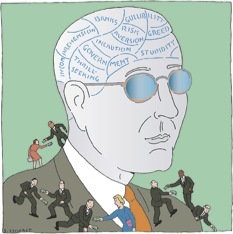
Taming Your Inner Homer Simpson
My Kellogg students will remember that I asked them to rate their intelligence vis-a-vis the average member of the class. I routinely had 75 percent of all student who rate themselves above average. That is 25% too many. A colleague of mine warned me that 90% academics feel undervalued by their institution. But until now… More »
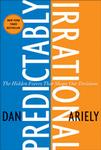
The Latest Reasoning about our Irrational Ways
Elizabeth Kolbert reviews in the New Yorker the latest on findings on how people behave in irrational ways when making economic decisions. Read her Reviews of two new books.
“Predictably Irrational: The Hidden Forces That Shape Our Decisions” (Harper; $25.95); by Ariely, Dan;
“Nudge: Improving Decisions About Health, Wealth, and Happiness” (Yale; $25); by Thaler, Richard H.

December 27, 2007 · Psychology Research
Malcom Gladwell Reviews the Problems with IQ Measurements
This is an excellent piece that shows how important it is to actually understand how IQ measures are constructed. Any empirical researcher can learn from the New Zealander who showed how much the alleged genetic intelligence is socially constructed. Read NONE OF THE ABOVE: What I.Q. doesn’t tell you about race.

September 30, 2005 · Psychology Teaching
Even the Best Cannot Predict the Future
It is very useful to recognize that the social world is too complex to predict well what will succeed and what will fail. Those who think they know with great certainty what will succeed run the danger of overinvesting in their pet scenarios. What is the lesson? Just like with stocks, we should always have a portfolio of beliefs about the future, reducing the risk of getting stuck with the wrong scenarios.
“I think there is a world market for maybe five computers.”
–Thomas Watson, chairman of IBM, 1943
Computers in the future may weigh no more than 1.5 tons.”
–Popular Mechanics, forecasting the relentless march of science, 1949
“I have traveled the length and breadth of this country and talked with the best people, and I can assure you that data processing is a fad that won’t last out the year.”
–The editor in charge of business books for Prentice Hall, 1957

July 3, 2005 · Psychology Teaching
The Freedom Tower Case: Why is group decision making not better individual decisions
Individual human beings have limited skills, knowledge, and expertise can get carried away by emotions when making decisions. One would think that involving multiple people in a decision could overcome the limitations of individual decision making but social psycholgoists have long known that groups have their own limitations. The New York Times published a pertinent article on how a comittee came up with the redesigned Freedom Tower that architectual critics find dissappointing given the grandeur of the originial proposal.

January 20, 2005 · Psychology Teaching
Four More Years of Happiness
Harvard pychology professor Daniel Gilbert predicts that most democrats will not be depressed during the next four years of George Bush. Here is the rationale that he offers in today’s New York Times: Research suggests that human beings have a remarkable ability to manufacture happiness. For example, when people in experiments are randomly awarded one of two equally valuable prizes, they quickly come to believe that the prize they won was more valuable than the prize they lost. They are often so surprised by their apparent good fortune that they refuse to believe the prize was awarded randomly, and they are generally unwilling to swap their prizes even when the experimenter offers to sweeten the deal with a little extra cash.

January 11, 2005 · Psychology Teaching
Gladwell and Surowiecki Debate How Good Decisions are made
Galdwell and Surowiecki have a new books coming out concerned with good decision making. I am presently reading Surowieki’s The Wisdom of Crowds and have Blink on my reading list. You can read a debate they both had about their books in Slate