
My Notes — Management


List of firms how superior performance cannot be explained by randomness
Andy Henderson and his coauthors have done us a great service. They are analyzed last decades to find a list of firms whose superior performance cannot be explained by randomness.
Although sustained superior firm performance may arise from skillful management or other valuable, rare, and inimitable resources, it can also result from randomness. Studying U.S. companies from 1965–2008, we benchmark how long a firm must perform at a high level to be confident that it is something other than the outcome of a time-homogeneous stationary Markov chain defined on the state space of percentiles. We find (a) the number of sustained superior performers in Compustat, measured by ROA and Tobin’s q, exceeds the number of false positives we would expect to be generated by such a process; yet (b) the occurrence of false positives is often enough to fool many observers, so (c) the identification of sustained superior performers requires particularly stringent benchmarks to enable valid study.
Read Full Article
Click on More to see the list of firms.


October 23, 2011 · Management Teaching
Steve Jobs’s Seven Rules of Success courtesy of Carmine Gallo
PM: I have followed Apple since 1985 and I think Carmine Gallo has correctly identified seven principles that Steve Jobs followed. I am presently doing research on why Apple was such a poorly managed company before Jobs was fired. Anyone who has insight on this, please contact me. When Jobs came back to Apple, lead… More »


Rudy Giulani’s Six Principles of Leadership
I am only a moderate fan of Rudy Giulani, but I strongly agree with the 6 (eight) principles of leadership he recently shared at a conference in Sydney as reported in BRW, June 23-29, 2011, p. 50. 1. Leaders have strong belief and vision You can't expect to have people follow you if you don't… More »

Burt Teplitzky on Using Humor in Sales Pitches
THE WALL STREET JOURNAL: How do you go about incorporating humor into sales presentations? I use humor to reinforce a point in selling a product or service. My formula is punch them with the joke, stick them with the point and leave them with the benefit. When you take a joke and incorporate it into… More »

Andy Penn’s Tips for Doing Business in Asia
1. Be patient. 2. Focus on building relationships. 3. Get the right people and invest in them. 4. Have a high level of cultural sensitivity and awareness. 5. Diversify across Asian markets as the risks are higher. 6. Build a regional model with a distinct platform that can handle all different tax and regulatory environments.… More »

April 17, 2011 · Management Teaching
CEO Q&A: Ned Montarello
What is your number one tip for managing people? Honest and open dialogue, synergise personal and company goals, position these around a framework to measure success, then let them get on with it. What is your number one tip for managing business? Recognise your strengths and weakness then surround yourself with key people whose skill… More »
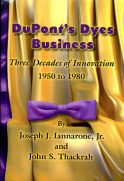
Review of DuPont?s Dyes Business: Three Decades of Innovation, 1950-1980
Joseph Innarone and John Tackray are two former members of the DuPont dye business that experienced its golden age after World War II and was sold off in 1979, marking the visible onset of the decline of the U.S. synthetic dye industry. The authors are not research chemists. For the entire period covered by the book, they both held different jobs in the dye business, spanning technical service, sales, and business management. In course of their various assignments that started for both of them as trainees in the Technical Laboratory, the authors acquired substantial knowledge of dye innovations and the business of selling dyes. Rather than attempting a scholarly history (only five sources are cited), the authors offer their own personal history of Du Pont’s dye business. Their story is valuable for anyone who wants to gain a deeper understanding how DuPont became an innovator in the synthetic dye industry yet in the 1970s could no longer compete successfully with foreign rivals. Du Pont exited the industry in 1979 as later did all other U.S. headquartered firms. Download full Review in AMBIX, Vol. 57 No. 3, November, 2010.