

Jeff Bezos explains in an annual letter to shareholders that Amazon bans PowerPoint presentations. Six-Page Narratives We don’t do PowerPoint (or any other slide-oriented) presentations at Amazon. Instead, we write narratively structured six-page memos. We silently read one at the beginning of each meeting in a kind of “study hall.” Not surprisingly, the quality of… More »
My Notes — Management

What Does the Success of Tesla Mean for the Future Dynamics in the Global Automobile Sector?
After reading Jacobides, MacDuffie, and Tae (2016), the success of Tesla in launching a new automobile company in a crowded sector puzzled us. Jacobides, MacDuffie, and Tae (2016) had convinced us that developing the capabilities to become the manufacturer of a complete, safe automobile system would be quite difficult. Researching the development history of Tesla,… More »

Interview with Professor Denise Rousseau
If you have been taught that relationship conflict (A-conflict) in teams is bad for team performance but arguing about tasks (C-conflict) is good, I encourage you to read my wide-ranging interview in BusinessThink with Professor Denise Rousseau (Carnegie Mellon University), the originator of this idea. After seeing the systematic evidence, she changed her mind and… More »

More Exploration and Less Exploitation: Cultivating Blockbuster Papers for MOR
Let me invite you to travel in your mind to the year 2030. Imagine that you are one of the Senior Editors of MOR and have been asked by the Editor-in-Chief to write a short retrospective on the previous 15 years. Delighted to take on this task, you compose an editorial along these lines: [I]Dear… More »

December 24, 2016 · Management Teaching
Brick and Mortar Retailers 2006 and Now
Amazon gained a lot more value then the big brick and mortar retailers list. But would this still be the case if the value destruction at all the small retailers that Amazon put out of business were accounted for? Think of Cody’s bookstore in Berkeley. 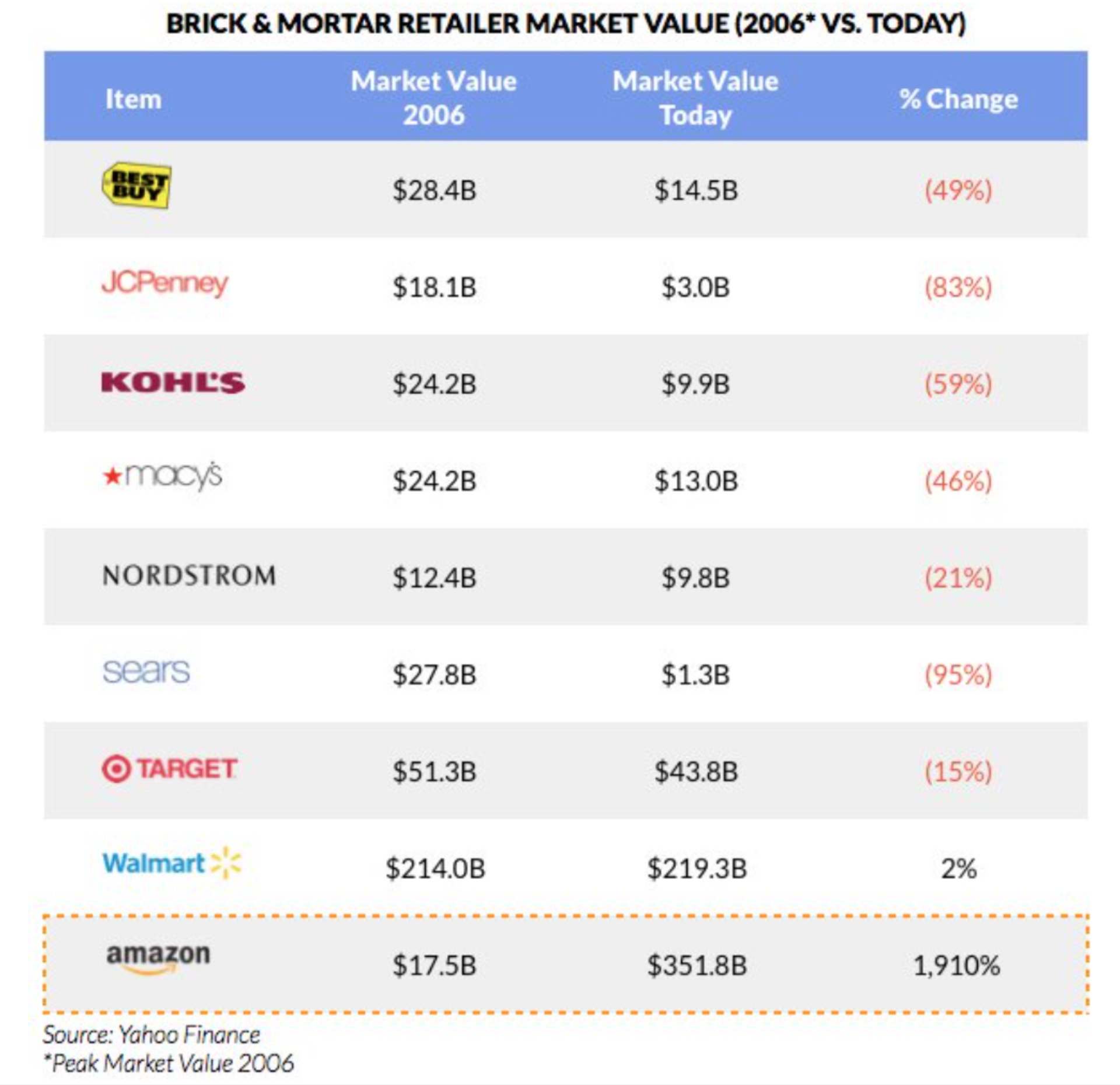

Carol Dweck: Differences between Growth and Fixed Mindsets
Carol Dweck has spent her career studying how personality traits impact life outcomes. Here is it summarized into one chart.

You can see a larger image by clicking here: Full Size Image

Useful if you consider submitting to AMJ: Editorial Statement by Current Editor of AMJ
I just read the editorial statement of the current editor of AMJ. If you would like to write about big problems that managers are facing in a scholarly way, AMJ may be a great outlet. Gerry George writes: A compelling way to frame a study for theoretical contribution is by asking questions on important anomalies… More »

October 18, 2014 · Management Research
Superb Example of Strategy Process Research: New Paper by Laurent Mirabeau and Steve Maguire in SMJ
I just read a fantastic research paper that I recommend highly to anyone who is interested in strategy process research.
Mirabeau, L., & Maguire, S. 2014. From autonomous strategic behavior to emergent strategy. Strategic Management Journal, 35(8): 1202-1229.
The authors do wonderful job first summarizing the different strands in strategy process research. Then they present new findings on how autonomous strategic initiatives become emergent strategy. They introduce the new idea of Ephemeral Autonomous Behavior to balance out the traditional Mintzberg model of emergent strategies. I have added the paper to my list of exemplary case studies worthy of imitation.
The core of the paper is nicely summarized in these two figures.
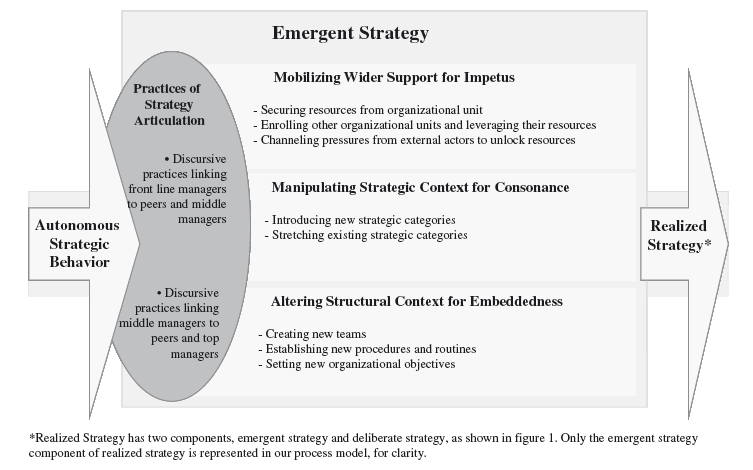
(Right click on each figure to open it in a larger format on a new page.)

May 14, 2014 · Management Research
How Fast Can Firms Grow?
Abstract: Building on recent research on dynamic, high-growth firms—so-called “gazelles”—this paper explores a simple question that is important in both theoretical and practical terms: What is the fastest rate at which firms can grow? Based on a sample of seven high-growth firms (Cisco, GM, IBM, Microsoft, Sears, Starbucks, and US Steel), we find that 162%… More »

March 31, 2014 · Management Teaching
What Employers value the most in MBA graduates
A recent survey of CEOs reveals what they are looking for in today’s MBA graduates:
Self-Awareness (62%)
Integrity (60%)
Cross-Cultural Competency (57%)
Team Skills (49%)
Critical Thinking (48%)
Communication (48%)
Comfort with Ambiguity and Uncertainty (41%)
Creativity (27%)
Execution (21%)
Sales (19%)
Source: PoetsandQuants.com