

Richard Nelson explained why is worthwhile to revisit his book. Over thirty years ago I wrote an extended essay, The Moon and the Ghetto, concerned with the troubling question of why societies so rich and capable technologically and organizationally as to be able to land a man on the moon seemed unable to deal effectively… More »
My Notes — Innovation
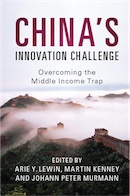
“China’s Innovation Challenge” published with Cambridge University Press
Arie Lewin, Martin Kenney and Johann Peter Murmann edited a new book on China's Innovation Challenge: Overcoming the Middle-Income Trap. New March 2016: Download Fronter Matter and Introductory Chapter The book will also feature contributions from Justin Yifu Lin, Gordon Redding, Michael Witt, Keun Lee, Douglas Fuller, John Child, Simon Collison, Yves Doz, Keeley Wilson,… More »

The role of home country demand in the internationalization of new ventures
My article with Salih Ozdemir and Deepak Sardana was just published in Research Policy. Abstract: International new ventures (INVs) have been documented to exist all around the world, but the literature is silent on the frequency of such companies in different countries. We contend that the propensity of new ventures to internationalize by forming international… More »

March 23, 2015 · Innovation Teaching
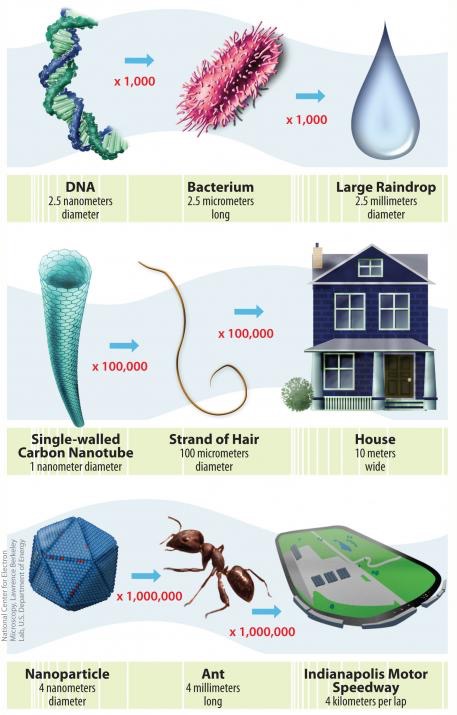
Getting a better sense of just how small a nanometer is
I am doing a bit of research on history and prospects of nano technology. Since 2000 the US government has an a nano technology initiative to ensure that the country stays what people consider a radical new technology to create new materials and structures. The chips in our computers and smartphones are getting ever more powerful because engineers are able to use nano technology to pack ever more transistors onto a chip. In addition to providing useful short history of nanotechnology, Nano.gov gives an useful illustration just how small is “nano”?

CEO of Large German Publisher speaks out: Why we fear Google
This if one of the most interesting open letter I have ever read by a CEO. Mathias Döpfner, CEO of Axel Springer, closes his open letter: Dear Eric Schmidt, you do not need my advice, and of course I am writing here from the perspective of those concerned. As a profiteer from Google’s traffic. As… More »

February 18, 2014 · Innovation Research
Joel Mokyr Sees no End to Innovation
Mokyr points out the modern GDP measures are not accounting for improvements in quality of products and life. He sees no end to innovation. Basic science needs to be funded by governments because private individuals and corporations cannot appropriate the returns from these investments. He sees culture that encourages natural skepticism of students as a… More »

AOM 2013: Two workshops I am participating in: History and Design Evolution
History and Strategy: Toward an Integration of Theory and Method History and Strategy
[color=red]New Presentation Slides for Download. [/color]Click here.
Program Session #: 80 | Submission: 14401 | Sponsor(s): (BPS, MH, TIM)
Scheduled: Friday, Aug 9 2013 11:45AM – 1:45PM at WDW Swan Resort in Swan 10
Organizer: Steven Kahl; Dartmouth College (TUCK);
Organizer: Brian S. Silverman; U. of Toronto;
Participant: David A. Kirsch; U. of Maryland;
Participant: Huseyin Leblebici; U. of Illinois;
Participant: J Peter Murmann; Australian School of Business, UNSW;
While historical research has played a central role in the development of the strategy literature, it remains underrepresented in strategy journals. This PDW explores how historical analysis can inform strategy research. As the strategy field continues to develop dynamic models of strategy, the historical perspective can provide unique perspective, and could potentially even develop a history-based theory of strategy. Yet, doing historical research in strategy faces methodological challenges given its different approach to the development of theory and use of evidence. Consequently, this PDW addresses the different opportunities available to strategy scholars to engage in the historical method. The format of the PDW is a combination of 1) presentations in which scholars experienced in conducting historical analysis within the strategy and organizational fields discuss the challenges of doing this work and 2) interactive breakout sessions in which participants break into smaller groups to discuss design of a historical study in topical strategy research areas, such as dynamic capabilities and industry evolution. These breakout sessions will help identify how the historical approach can make novel theoretical contributions and reveal roadmaps for pushing this work further.
Search Terms: History/Historical Analysis , Strategy , Theory and Methods
Architectural Strategy and Design Evolution in Business Ecosystems: Opportunities and Challenges
Ecosystem Design and Strategy
Program Session #: 279 | Submission: 10331 | Sponsor(s): (TIM, BPS, ENT, OMT)
Scheduled: Saturday, Aug 10 2013 10:15AM – 12:45PM at WDW Swan Resort in Swan 3

Honoring the late Steve Klepper
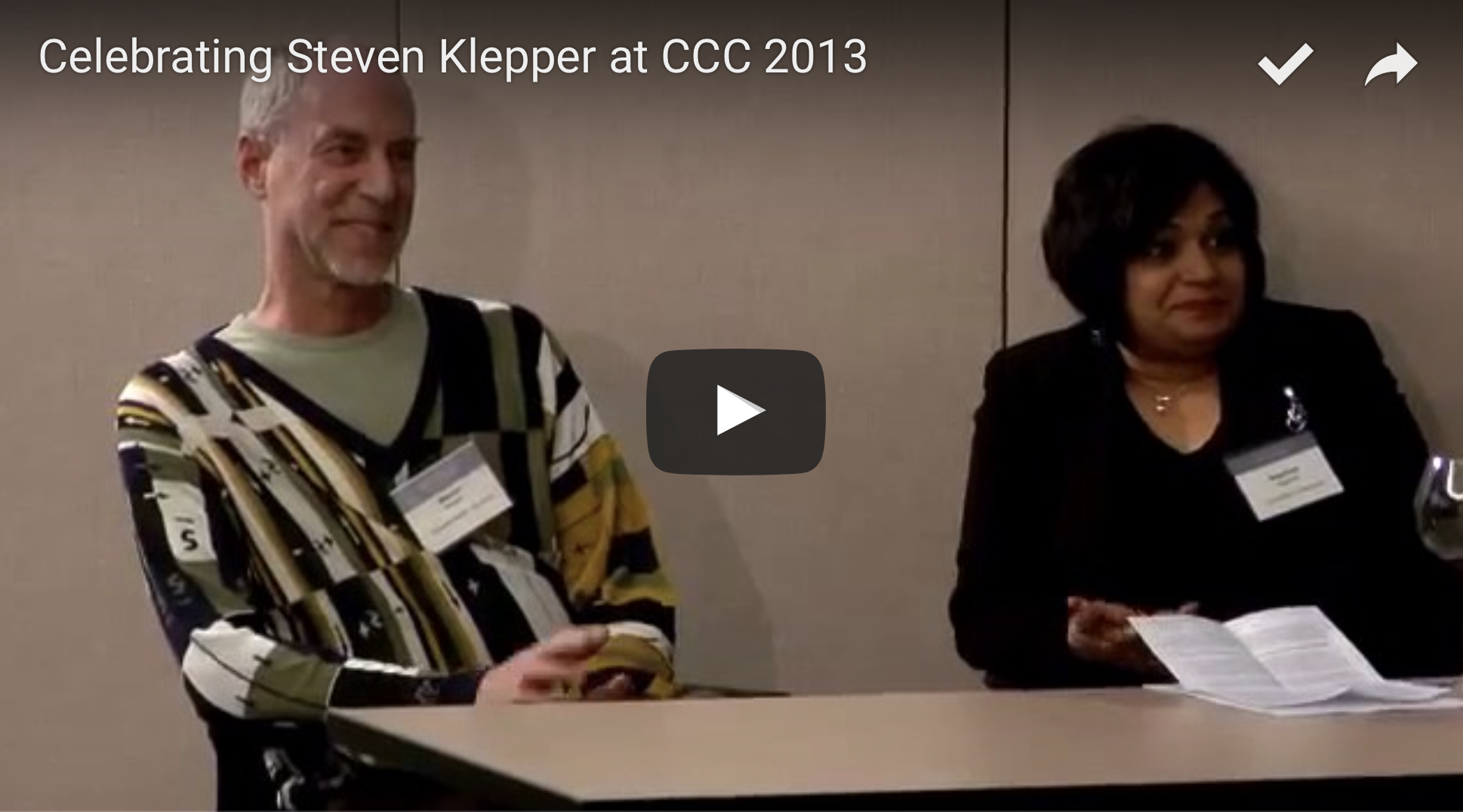
Steve Klepper, who has been an inspiration to so many of us, recently passed away. At the 20th anniversary of the CCC colloquium, we honored Steve Klepper. The video captures very nicely how much Steve touched an entire generation of doctoral students working on the intersection of industry evolution and technological innovation.
Nelson, Richard R. (born 1930)
This short article is my entry on Richard R. Nelson in the Encyclopedia of Strategic Management
Richard R. Nelson (b. 1930) is an American economist who has had a significant influence on the field of strategic management. The fundamental question driving his work is how societies can be organized to improve their material well-being. In answering this question, Nelson identifies sustained technological innovation and a diverse range of often industry-specific institutional structures as the key engines of economic growth. He sees business firms as playing a key role in the growth process because firms are the carriers of the knowledge and abilities required to produce the complex product and services that characterize modern economies.
Keywords: evolutionary theory, firms, innovation, organizational capabilities, patents, Carnegie School, RAND Corporation; science policy, tacit knowledg

Announcing a Special Feature: “Letters from China”
During the first two weeks of June, I will visit China for the first time. To share my impressions, I plan to write a few Letters from China. Today I want to give you a bit background on the trip. For a long time, I wanted get out behind my desk and see China with my own eyes. This visit is long overdue given that I started to research the development of the Chinese synthetic dye industry five years ago.
The goal of my visit is to get a deeper understanding of what the future of China will likely look like. More specifically, I want to become more knowledgeable about whether China will become the world leader in high-tech industries and if so how. For this reason, I want to build connections with people in China who are participating in or following these developments. Until now I have been relying on Hong Jiang to be my eyes in China. I recruited her from China to write her doctoral thesis under my supervision. Together we published an article entitled Regional institutions, ownership transformation, and migration of industrial leadership in China, showing how the leading centers of synthetic dye production industry shifted twice in the period from 1978 to 2008 because of differences in the institutional composition of regions within China. Hong is currently back in the field trying to find more evidence on how personal networks allowed entrepreneurs to access crucial knowledge from established firms. Our particular challenge is to find knowledgeable people from companies that went out of business so we can establish with more certainty that they lacked the personal contacts that allowed their rivals to be more successful.
It is important to realize that synthetic dye technology was developed in the West decades ago and has become stagnant. This is why Chinese firms could become the largest producers in the world by simply imitating product innovations made abroad. Now, I am looking for one or more industries where Chinese firms are not simply copying innovations made abroad but where they are at the frontier of global knowledge. If you think you know such an industry, please contact me. After my trip to China, I hope to have a better sense of the kind of high-tech industries in which China may be pushing the global knowledge frontier.
To avoid false expectations, let me emphasize that I am not writing my Letters from China as a “China expert.” I am very well versed in Western social theory and, more specifically, evolutionary theory in the social sciences: As an evolutionist, I have strong theoretical commitment that success is built on a mountain of failures. Or, to put it more simply: China cannot become the leader in a sector without trying out many things and figuring out what works through experience. (I lay out this perspective in non-technical terms in Scaffolding in Economics, Management, and the Design of Technologies). But I have modest credentials regarding the “facts on ground” in China. Aside from what Hong Jiang taught me, I can trace most of my knowledge about China to three books that I found particularly useful.