

Jeff Pfeffer has spent the past twenty years figuring out what management ideas have some systematic data behind them and what ideas are make for a good story but are simply wrong. Guy Kawasaki (who wrote a fantastic little book on entreprepreurship, The Art of the Start, which I am using in one of my… More »
My Notes — Bookshelf

What Don Quixote Can Teach Managers and Entrepreneurs
Miguel de Cervantes. 2003. Don Quixote. HarperCollins Publishers, New York. Translated by Edith Grossman.
When I first encountered Don Quixote, I thought that a manager or entrepreneur could not possibly learn anything from this lunatic Spaniard. But on reflection I realized that Don Quixote provides some valuable insights into leadership and the challenge of dealing emotionally with the uncertainties inherent in any new venture. Let me briefly summarize the book:

Taming Your Inner Homer Simpson
My Kellogg students will remember that I asked them to rate their intelligence vis-a-vis the average member of the class. I routinely had 75 percent of all student who rate themselves above average. That is 25% too many. A colleague of mine warned me that 90% academics feel undervalued by their institution. But until now… More »
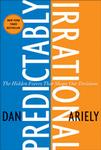
The Latest Reasoning about our Irrational Ways
Elizabeth Kolbert reviews in the New Yorker the latest on findings on how people behave in irrational ways when making economic decisions. Read her Reviews of two new books.
“Predictably Irrational: The Hidden Forces That Shape Our Decisions” (Harper; $25.95); by Ariely, Dan;
“Nudge: Improving Decisions About Health, Wealth, and Happiness” (Yale; $25); by Thaler, Richard H.

April 26, 2008 · Bookshelf
Welcome to My Blogs
I have created a number blogs to publish useful information. One is a Teaching Blog dedicated to providing past, present and future students useful information. My Research Blog is dedicated to disseminating useful information to other researchers and scholars. A new blog is focused on how to improve forecasts, which is a key strategic skill:… More »

Irrational fear: No good at risk
The Economists reviews of “Risk: The Science and Politics of Fear” by Dan Gardner
THE official death toll from the September 11th terrorist attacks in 2001 was 2,974. But in 2002 America’s death toll on the roads grew by more than 1,500—casualties of the terrorism-inspired exodus from safe aeroplanes to dangerous motor cars. A swan washes up on a British shore, dead from bird flu, and the press panics, while the 3,000 people who die every year on the country’s roads (13 times the number of people who have ever died from bird flu) go largely unremarked. Human beings are notoriously bad at dealing with risk. Two new books explore why, and investigate the effects that misunderstanding risks can have on public policy. The first, an excellent work by a Canadian writer, Dan Gardner, is a broad meditation on the nature of risk, beginning with a psychological explanation for why people find it so difficult to cope. Mr Gardner analyses everything from the media’s predilection for irrational scare stories to the cynical use of fear by politicians pushing a particular agenda.

What CEOs are Reading
The common perception is that CEOs are reading the latest popular management books to help them with their difficult job. An article in the New York Times suggests otherwise. I am not sure if the CEOs that Harriet Rubin portrays in here article are representative of all CEOs and I think the title of the article “C.E.O. Libraries Reveal Keys to Success” is an overstatement, but any manager should read what she has to say.
Harriet Rubin: Michael Moritz, the venture capitalist who built a personal $1.5 billion fortune discovering the likes of Google, YouTube, Yahoo and PayPal, and taking them public, may seem preternaturally in tune with new media. But it is the imprint of old media — books by the thousands sprawling through his Bay Area house — that occupies his mind. “My wife calls me the Imelda Marcos of books,” Mr. Moritz said in an interview. “As soon as a book enters our home it is guaranteed a permanent place in our lives. Because I have never been able to part with even one, they have gradually accumulated like sediment.” Serious leaders who are serious readers build personal libraries dedicated to how to think, not how to compete. Ken Lopez, a bookseller in Hadley, Mass., says it is impossible to put together a serious library on almost any subject for less than several hundred thousand dollars. Perhaps that is why — more than their sex lives or bank accounts — chief executives keep their libraries private.
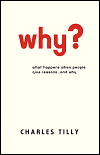
Malcom Gladwell Reviews Charles Tilly’s New Book “WHY”
Gladwell writes: In "Why?" (Princeton; $24.95), the Columbia University scholar Charles Tilly sets out to make sense of our reasons for giving reasons. In the tradition of the legendary sociologist Erving Goffman, Tilly seeks to decode the structure of everyday social interaction, and the result is a book that forces readers to reexamine everything from… More »
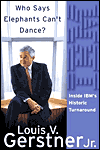
Who Says Elephants Can’t Dance: Inside IBM’s Historic Turnaround
In the early 1990s, IBM was in danger of going bankrupt. Loius Gerstner was called in to turn the company around. Anyone who is trying to change a formerly successful orgazation will benefit from reading Gerstner's thoughts on change management. Beware: the book starts out slow, turning off many readers. But after the first 20… More »

Malcom Gladwell’s Book “Blink” is out!
In my introductory management class I discuss the how cognitive heuristics (rules of thump) help us navigate our complex daily lives and make decisions before it is too late. Malcom Glawell new book describes this quick decision-making capability with many examples. I will review the book during the next couple of months, but in the… More »